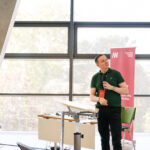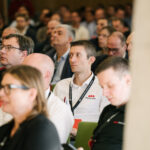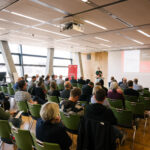
After a ten-year break, the Automic community finally met again in person. Automic World 2026, hosted by Broadcom as the Automic World Revival, took place on 29–30 October at the darmstadtium in Darmstadt, with almost 200 participants, the Broadcom product team and partners from across the ecosystem. Tricise was there with a full team and was on stage twice: in the panel discussion on AI in enterprise automation, and with our own session on Automic Automation as a SOAP for infrastructure automation. This recap covers both and includes our presentation to download.
Why the comeback mattered
Ten years is a long time in automation. Since the last Automic World, Automic SaaS has become a real option, and AI has entered almost every conversation about operations. What had been missing was a place where the people who run Automic every day could compare notes face to face.
That is exactly what Darmstadt delivered. The sessions were good, but the corridors and coffee breaks were where the real exchange happened: upgrade stories, practical tips, and many “how do you handle this?” conversations. The feedback we heard from customers was remarkably consistent: events like this are needed, and the community wants more of them. Broadcom summed it up in its own thank-you note as a revival that was a full success.
Panel discussion: from hype to reality
The afternoon panel, “From Hype to Reality: How AI is Reshaping Enterprise Automation Today”, brought together representatives of Broadcom, Dicos, Setis, Fujitsu and Tricise, with Martin Winkler representing us on stage.
The discussion covered both the present and the future: where AI already adds value in enterprise automation today, and where it is heading. For Martin, the direction is clear:
“We are all competing under enormous international pressure. In the end, every company will have to take automation and AI as far as they can go, just to stand a chance. At some point, even a half-percent lead in automation and AI will make the difference in the market, and every manual intervention will become a competitive disadvantage. That makes AI not just a technical question, but a human one with real social consequences. Even so, we cannot afford to shy away from this change. The challenge is to shape it without losing control.”
At Tricise, we see AI as an enabler for complex situations that call for flexibility. For now, it complements classic workload automation rather than replacing it. AI is cheap today, but that is unlikely to last. Whether companies rely on external providers or run private AI models themselves, they should keep an eye on where token prices are heading and plan for higher costs. Otherwise, AI can lead them into a dependency they never wanted.
Our session: Automic Automation as SOAP for infrastructure automation
Many still think of Automic as a job scheduler. In his session, Martin Winkler showed what it can do as a full service orchestration and automation platform (SOAP): Automic builds environments on request, delivers access, keeps track of the runtime and cleans everything up at the end. At Tricise, this runs in production, for customers in the e-learning courses, trainer-led trainings and labs of our Tricise University, and internally for everything from replicas of customer environments to upgrade tests and demo systems.
The starting point: slow setup, forgotten cleanup
Setting up a client with users, rights, objects and an agent, let alone a complete VM, takes many manual steps. Requests wait until someone has time, and the course, test or demo waits with them. Once the work is done, the environment often keeps running and blocks capacity that the next request needs.
Three scenarios, one lifecycle
Automic sits at the center and connects everything involved: the e-learning platform and shop via the AE REST API, email, the V24 and V26 systems, the hypervisor and the AI. Three scenarios run through the same lifecycle: a dedicated client for user and developer courses, a complete VM for admin and installation courses, and an AI-built VM for internal requests. Automic controls every station:
- Requested: via the AE REST API or by email. Automic accepts the request and determines the scenario.
- Provisioned: a fully configured client on a V24 or V26 system, or a complete VM built on the hypervisor by scripts on Automic agents.
- Used: access arrives by email, as AWI credentials or as a link to Apache Guacamole for browser access to the VM. Under load, Automic gives VMs more CPU and RAM, up to a set limit.
- Pre-warned: an email shortly before expiry. A simple reply extends the runtime.
- Decommissioned: the client or VM is removed, and the capacity is free for the next request.
Because every environment has an end date from the start, nothing keeps running unnoticed.
Where AI comes in: from WAR file to software stack
Internally, every request is different, and no course defines what the environment should look like. This is where AI comes in, and it does much more than interpret a free-text request. It can analyze WAR files and other artifacts, work out what an application needs to run, such as the Java version, application server and database, and assemble a matching software stack together with the specification for the VM.
Automic then checks the specification for format and completeness, provisions the VM, installs the stack and hands over access, fully automatically and without manual approval. From there, the environment runs through the same lifecycle as every other request. The AI covers what is hard to capture in fixed rules, while Automic orchestrates everything around it and keeps every step under control. The AI itself is interchangeable, so you are free to use the model of your choice.
Transferable to your landscape
The pattern works well beyond our own use cases. Requests can come from a self-service portal, an ITSM tool or a CI/CD pipeline, with an approval step wherever your policies require one. Much of it builds on standard Automic features: since V24.1, the AE REST API can create clients and set up users directly in the target client, and the same API stops and deletes clients at the end. If you’d like to see how this could work in your landscape, talk to our Automic Automation team.
Download our Automic World 2026 presentation
Want to see the full lifecycle, the three scenarios and the architecture diagrams? Open Martin Winkler’s slides on Automic Automation as SOAP for infrastructure automation (PDF). One click opens the deck directly in your browser. Please note the slides are in German.
The slides from the other sessions, including the keynote and the roadmap, are on Broadcom’s Automic World Revival on-demand page.
The event in pictures
We put together a short video with impressions from both days in Darmstadt: the stage, the sessions and the people who made Automic World 2026 feel like a real reunion.
What comes next
Will there be another Automic World? Broadcom is already planning, but there is nothing concrete yet. As soon as there is news, we will share it on our events page.
In the meantime, the community continues closer to home. Our Automic Roundtables by Tricise bring users together in smaller groups for practical exchange. Several customers told us in Darmstadt that they would like to meet again before the end of the year, so the next stop is Zurich on 10 December 2026. If you missed Automic World 2026, it is a good chance to catch up in person.
Frequently asked questions
Where can I download the Tricise presentation from Automic World 2026?
The slides of our session on Automic Automation as SOAP for infrastructure automation are linked in this post and open directly as a PDF. The slides from the other sessions are available on Broadcom’s Automic World Revival on-demand page.
Will there be another Automic World?
A next edition is being planned, but nothing concrete has been announced yet. As soon as there is news, Tricise will share it. Follow our events page to stay informed.
What does SOAP mean in the context of Automic Automation?
SOAP stands for service orchestration and automation platform. It describes using Automic not only as a job scheduler, but as the layer that orchestrates complete processes, for example provisioning and decommissioning servers, clients and software.
Can Tricise help us build a similar provisioning workflow?
Yes. The lifecycle shown in Darmstadt runs in production at Tricise and can be adapted to self-service portals, ITSM tools or pipelines. Contact our Automic Automation team to discuss your landscape.
Where can I meet Tricise next?
At the Automic Roundtable by Tricise in Zurich on 10 December 2026, starting at 4:00 PM at the 25hours Hotel Langstrasse. Registration is open on our events page.